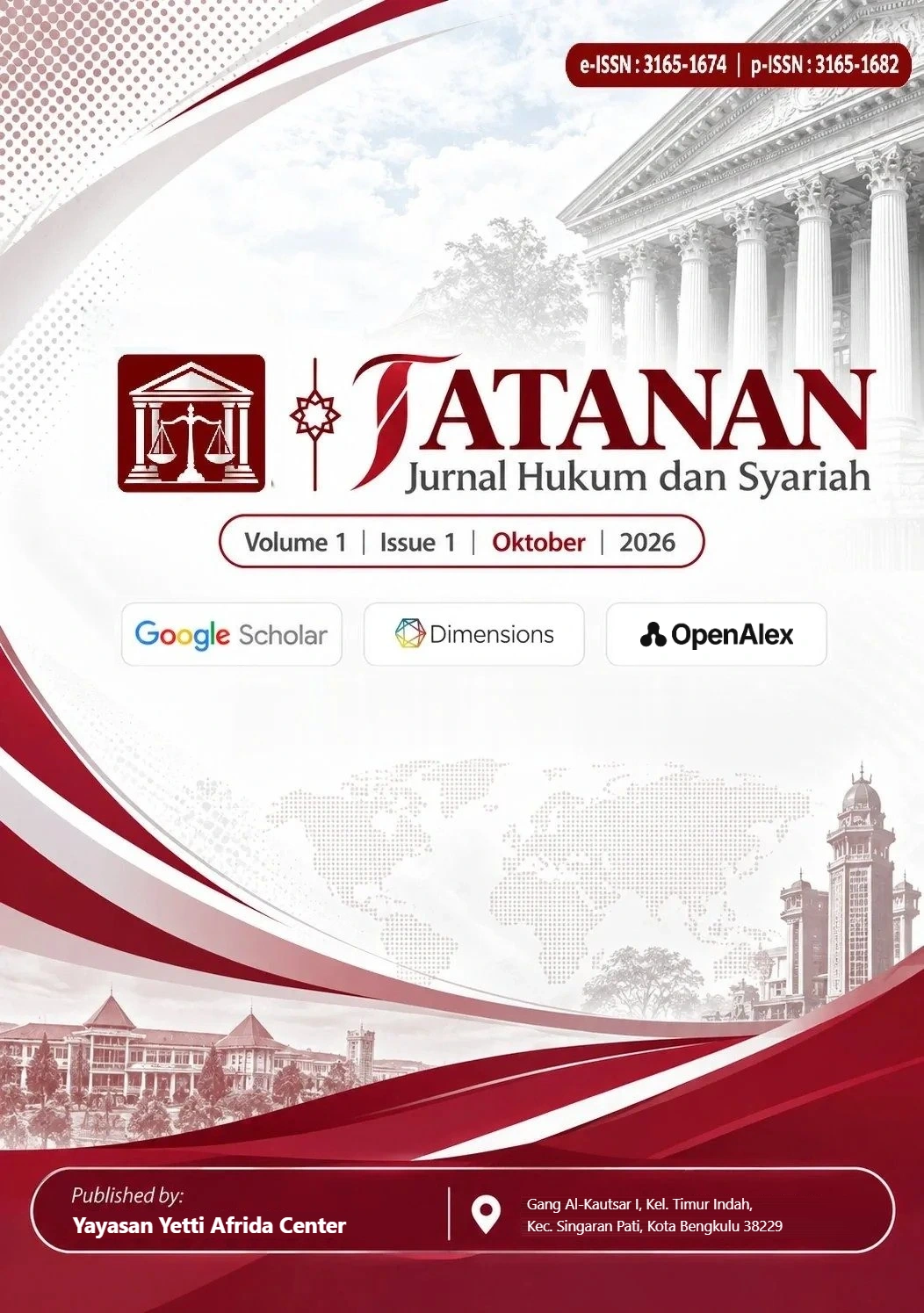
Artificial Intelligence in Islamic Financial Services: Reconstructing Consumer Protection Based on Maqashid al-Shariah
DOI:
https://doi.org/10.67319/tatanan.v1i1.1Keywords:
artificial intelligence, keuangan syariah, perlindungan konsumen, maqashid al-shariah, tata kelola algoritmaAbstract
Purpose: This article aims to reconstruct a consumer protection model for artificial intelligence (AI)-based Islamic financial services by positioning maqashid al-shariah as a normative framework that complements positive law and AI governance.
Design/Methodology: The study employs a normative juridical method with statutory, conceptual, and comparative-functional approaches. The primary legal materials include the Consumer Protection Law, the Personal Data Protection Law, the P2SK Law, POJK Number 22 of 2023, the OJK’s 2023 and 2025 AI guidelines, and the principles of Islamic economic law. Scholarly literature from 2022–2026 is analyzed thematically.
Findings: The findings show that the consumer protection regime already contains the principles of transparency, fair treatment, data security, complaint handling, and business-actor liability, but has not fully anticipated opaque algorithmic decisions, data bias, manipulative personalization, and unclear human accountability. The proposed reconstruction is Maqashid-Based AI Consumer Protection, which combines hifz al-mal, hifz al-nafs, hifz al-aql, hifz al-din, and hifz al-nasl with explainability, fairness, human oversight, privacy, sharia review, and effective remedy.
Practical Implications: The model can serve as a reference for Islamic banks, Islamic fintech companies, the Sharia Supervisory Board, and regulators in designing, auditing, and evaluating high-risk AI systems.
Originality/Value: The novelty of the article lies in shifting consumer protection from a passive compliance approach toward protection that is preventive, explainable, auditable, and oriented toward public benefit (maslahah).
Downloads
References
Ahmed, S., Alshater, M. M., El Ammari, A., & Hammami, H. (2022). Artificial intelligence and machine learning in finance: A bibliometric review. Research in International Business and Finance, 61, 101646. https://doi.org/10.1016/j.ribaf.2022.101646 DOI: https://doi.org/10.1016/j.ribaf.2022.101646
Amin, N. M. F., & Arifin, T. (2025). Analysis of consumer protection policy on the use of sharia fintech services in Indonesia. International Journal of Islamic Studies Issues. https://doi.org/10.59966/ep1kwv07 DOI: https://doi.org/10.59966/ep1kwv07
Das, S., Stanton, R., & Wallace, N. (2023). Algorithmic fairness. Annual Review of Financial Economics, 15, 565-593. https://doi.org/10.1146/annurev-financial-110921-125930 DOI: https://doi.org/10.1146/annurev-financial-110921-125930
De La Rosa, W., & Bechler, C. J. (2024). Unveiling the adverse effects of artificial intelligence on financial decisions via the AI-IMPACT model. Current Opinion in Psychology, 58, 101843. https://doi.org/10.1016/j.copsyc.2024.101843 DOI: https://doi.org/10.1016/j.copsyc.2024.101843
De Lange, P. E., Melsom, B., Vennerød, C. B., & Westgaard, S. (2022). Explainable AI for credit assessment in banks. Journal of Risk and Financial Management, 15(12), 556. https://doi.org/10.3390/jrfm15120556 DOI: https://doi.org/10.3390/jrfm15120556
Díaz-Rodríguez, N., Del Ser, J., Coeckelbergh, M., de Prado, M. L., Herrera-Viedma, E., & Herrera, F. (2023). Connecting the dots in trustworthy artificial intelligence: From AI principles, ethics, and key requirements to responsible AI systems and regulation. Information Fusion, 99, 101896. https://doi.org/10.1016/j.inffus.2023.101896 DOI: https://doi.org/10.1016/j.inffus.2023.101896
Fundira, M., & Mbohwa, C. (2025). AI ethics in banking services: A systematic and bibliometric review of regulatory and consumer perspectives. Discover Artificial Intelligence, 5, 319. https://doi.org/10.1007/s44163-025-00432-4 DOI: https://doi.org/10.1007/s44163-025-00432-4
Ghazi Ahmad, N. F., & Noor Zainan, N. I. (2025). AI, Shariah governance, and Maqasid Shariah in Islamic finance. International Journal of Research and Innovation in Social Science, 9, 9972-9977. https://doi.org/10.47772/IJRISS.2025.909000822 DOI: https://doi.org/10.47772/IJRISS.2025.909000822
Harits, M., & Isman. (2026). Artificial intelligence in Islamic finance: Maintaining Islamic ethics with the Maqasid al-Shariah framework. Proceeding ISETH. https://doi.org/10.23917/iseth.6929 DOI: https://doi.org/10.23917/iseth.6929
Hutagalung, J. M., Suminar, M. Z. A., Pebrianto, Z., Al-Kindi, M. I. S., & Masae, M. (2025). Digital lending platforms and Islamic financial technology in Indonesia: Reconciling regulatory paradigms through Maqāṣid al-Sharīʿah and consumer protection philosophies. Jurnal Indo-Islamika, 15(1). https://doi.org/10.15408/jii.v15i1.47045 DOI: https://doi.org/10.15408/jii.v15i1.47349
Kharisma, D. B. (2025). Artificial intelligence and Islamic finance industry: Problems and oversight. International Journal of Law and Management. Advance online publication. https://doi.org/10.1108/IJLMA-07-2024-0236 DOI: https://doi.org/10.1108/IJLMA-07-2024-0236
Meng, K., Mahapatra, M. S., & Xiao, J. J. (2025). Artificial intelligence and consumer financial behavior: A systematic literature review and agenda for future research. Journal of Consumer Behaviour, 24(4), 1755-1786. https://doi.org/10.1002/cb.2497 DOI: https://doi.org/10.1002/cb.2497
Downloads
Published
Issue
Section
License
Copyright (c) 2026 Anita Niffilayani

This work is licensed under a Creative Commons Attribution-ShareAlike 4.0 International License.