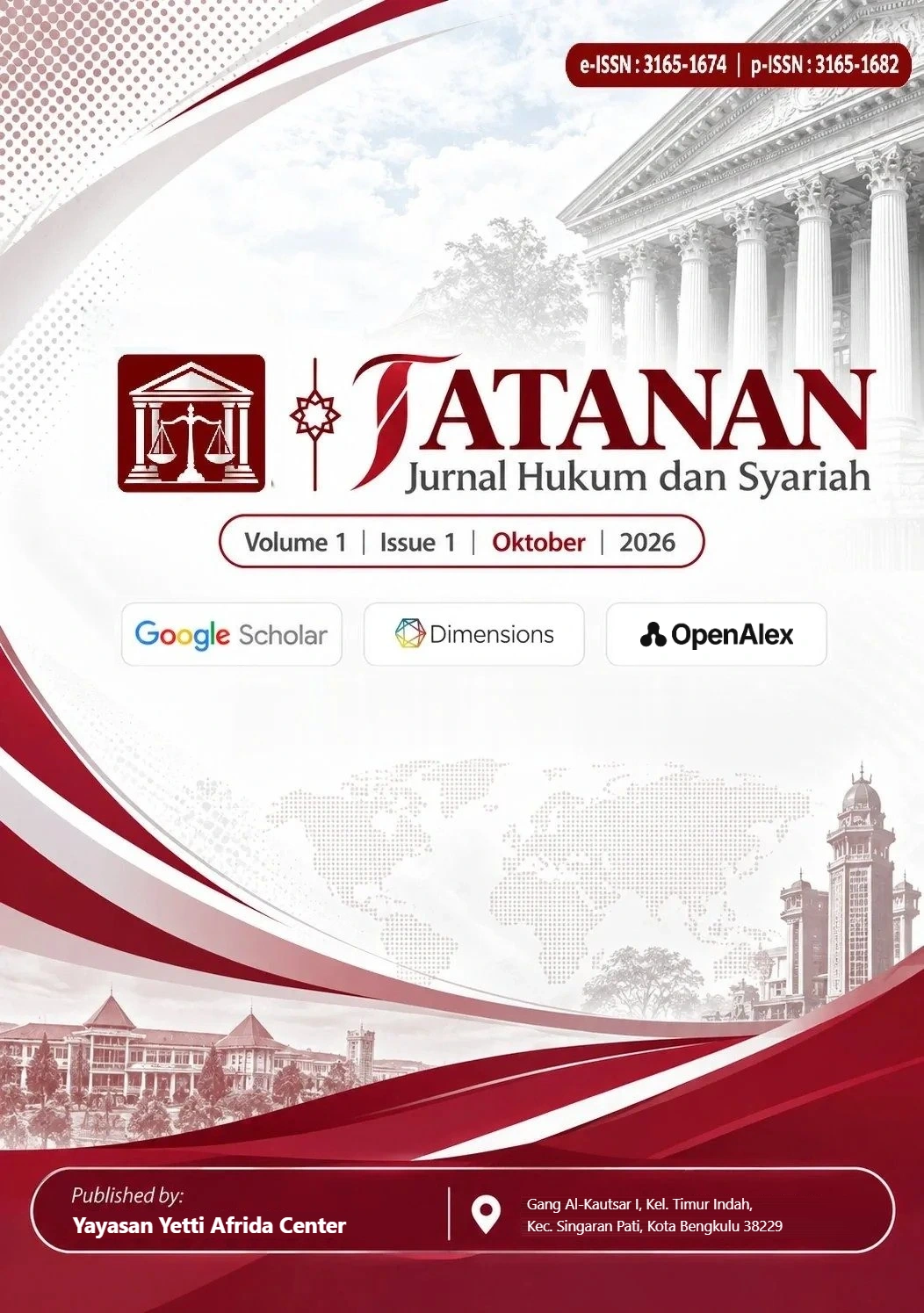
Algorithmic Accountability in Islamic Fintech: Perspectives on Islamic Law, Transparency, and Digital Justice
DOI:
https://doi.org/10.67319/tatanan.v1i1.3Keywords:
algorithmic accountability, intech syariah, transparansi, keadilan digital, maqashid al-shariah, xplainable AIAbstract
Purpose: This article analyzes algorithmic accountability in Islamic fintech by positioning Islamic law, transparency, and digital justice as three complementary layers of evaluation. The study focuses on how algorithm-based decisions on financing, credit scoring, fraud detection, product recommendations, personalization, and debt collection can be accounted for to consumers, regulators, and the Sharia Supervisory Board.
Design/Methodology: The study employs a normative juridical method with statute, conceptual, and comparative-functional approaches. The primary legal materials include the Consumer Protection Law, the Personal Data Protection Law, the P2SK Law, POJK Number 22 of 2023, SEOJK Number 18/SEOJK.08/2024, and the 2025 Indonesian Banking Artificial Intelligence Governance. Literature on algorithmic accountability, explainable AI, fairness, Islamic fintech, sharia governance, and maqashid al-shariah is analyzed thematically.
Findings: The findings show that algorithmic accountability cannot be reduced to code disclosure or technical explanation. Accountability requires the traceability of purposes, data, models, decisions, actors, and remedies; transparency layered according to the audience; testing of fairness and distributional impacts; contestability mechanisms; and the involvement of humans with real authority. The article proposes the Shariah Algorithmic Accountability Framework (SAAF), which combines amanah, ‘adl, maslahah, hifz al-mal, hifz al-aql, and the principle of la darar with model inventory, impact assessment, explainability, fairness audits, human review, sharia assurance, and effective remedy.
Practical Implications: The framework can be used by Islamic fintech companies, Islamic banks, technology providers, the Sharia Supervisory Board (DPS), compliance units, risk management, internal audit, and the OJK to build evidence of accountability from the design stage through post-implementation monitoring.
Originality/Value: The novelty of the article lies in conceptualizing algorithmic accountability as an auditable chain of legal and sharia responsibility rather than merely an ethical principle, and in combining the right to explanation, the right to contest decisions, fairness of outcomes, and sharia supervision into a single governance architecture.
Downloads
References
Akbar, S. A., Harun, M., & Elvia, E. E. (2026). Artificial intelligence credit scoring algorithm and compliance with Maqasid as-Syari'ah in digital Islamic financing. Muamalah, 12(1), 1-11. https://doi.org/10.19109/muamalah.v12i1.35545 DOI: https://doi.org/10.19109/muamalah.v12i1.35545
Binns, R. (2018). Fairness in machine learning: Lessons from political philosophy. Proceedings of Machine Learning Research, 81, 149-159.
European Union. (2024). Regulation (EU) 2024/1689 laying down harmonised rules on artificial intelligence (Artificial Intelligence Act). Official Journal of the European Union.
Kroll, J. A., Huey, J., Barocas, S., Felten, E. W., Reidenberg, J. R., Robinson, D. G., & Yu, H. (2017). Accountable algorithms. University of Pennsylvania Law Review, 165(3), 633-705.
NIST. (2023). Artificial Intelligence Risk Management Framework (AI RMF 1.0). National Institute of Standards and Technology. https://doi.org/10.6028/NIST.AI.100-1 DOI: https://doi.org/10.6028/NIST.AI.100-1.jpn
Otoritas Jasa Keuangan. (2023). Peraturan Otoritas Jasa Keuangan Nomor 22 Tahun 2023 tentang Pelindungan Konsumen dan Masyarakat di Sektor Jasa Keuangan.
Otoritas Jasa Keuangan. (2024). Surat Edaran Otoritas Jasa Keuangan Nomor 18/SEOJK.08/2024 tentang Penilaian Sendiri terhadap Pemenuhan Ketentuan Pelindungan Konsumen dan Masyarakat di Sektor Jasa Keuangan.
Otoritas Jasa Keuangan. (2025). Tata Kelola Kecerdasan Artifisial Perbankan Indonesia.
Republik Indonesia. (1999). Undang-Undang Nomor 8 Tahun 1999 tentang Perlindungan Konsumen.
Republik Indonesia. (2022). Undang-Undang Nomor 27 Tahun 2022 tentang Perlindungan Data Pribadi.
Republik Indonesia. (2023). Undang-Undang Nomor 4 Tahun 2023 tentang Pengembangan dan Penguatan Sektor Keuangan.
Selbst, A. D., Boyd, D., Friedler, S. A., Venkatasubramanian, S., & Vertesi, J. (2019). Fairness and abstraction in sociotechnical systems. Proceedings of the Conference on Fairness, Accountability, and Transparency, 59-68. https://doi.org/10.1145/3287560.3287598 DOI: https://doi.org/10.1145/3287560.3287598
Wieringa, M. (2020). What to account for when accounting for algorithms: A systematic literature review on algorithmic accountability. Proceedings of the 2020 Conference on Fairness, Accountability, and Transparency, 1-18. https://doi.org/10.1145/3351095.3372833 DOI: https://doi.org/10.1145/3351095.3372833
Wachter, S., Mittelstadt, B., & Russell, C. (2018). Counterfactual explanations without opening the black box: Automated decisions and the GDPR. Harvard Journal of Law & Technology, 31(2), 841-887. DOI: https://doi.org/10.2139/ssrn.3063289
OECD. (2024). Recommendation of the Council on Artificial Intelligence. OECD Legal Instruments.
Kharisma, D. B. (2025). Artificial intelligence and Islamic finance industry: Problems and oversight. International Journal of Law and Management. Advance online publication. https://doi.org/10.1108/IJLMA-07-2024-0236 DOI: https://doi.org/10.1108/IJLMA-07-2024-0236
Das, S., Stanton, R., & Wallace, N. (2023). Algorithmic fairness. Annual Review of Financial Economics, 15, 565- 593. https://doi.org/10.1146/annurev-financial-110921-125930 DOI: https://doi.org/10.1146/annurev-financial-110921-125930
Díaz-Rodríguez, N., Del Ser, J., Coeckelbergh, M., de Prado, M. L., Herrera-Viedma, E., & Herrera, F. (2023). Connecting the dots in trustworthy artificial intelligence: From AI principles, ethics, and key requirements to responsible AI systems and regulation. Information Fusion, 99, 101896. https://doi.org/10.1016/j.inffus.2023.101896 DOI: https://doi.org/10.1016/j.inffus.2023.101896
De Lange, P. E., Melsom, B., Vennerød, C. B., & Westgaard, S. (2022). Explainable AI for credit assessment in banks. Journal of Risk and Financial Management, 15(12), 556. https://doi.org/10.3390/jrfm15120556 DOI: https://doi.org/10.3390/jrfm15120556
Fundira, M., & Mbohwa, C. (2025). AI ethics in banking services: A systematic and bibliometric review of regulatory and consumer perspectives. Discover Artificial Intelligence, 5, 319. https://doi.org/10.1007/s44163-025-00432-4 DOI: https://doi.org/10.1007/s44163-025-00432-4
Auda, J. (2008). Maqasid al-Shariah as philosophy of Islamic law: A systems approach. International Institute of Islamic Thought. DOI: https://doi.org/10.2307/j.ctvkc67tg
Kamali, M. H. (2008). Maqasid al-Shari'ah made simple. International Institute of Islamic Thought. DOI: https://doi.org/10.2307/j.ctvkc67vz
Downloads
Published
Issue
Section
License
Copyright (c) 2026 Aziz Zakiruddin

This work is licensed under a Creative Commons Attribution-ShareAlike 4.0 International License.